Chimera Shih Tzu
We have compiled a list of favorite & recommended items to help you plan your puppy coming home.
CHIMERA SHIH TZU
Welcome to the Chimera Shih Tzu family and congratulations on your new puppy. We hope this pup brings you many years of joy and companionship. We love hearing about them as & seeing photos or videos they grow up. Feel free to send updates anytime!
Please also send us any questions or concerns you have at any point in time. We are always here to help, no matter what the situation.
If you ever find yourself in the unexpected and unfortunate situation of needing to find another home for your Chimera Shih Tzu, we are here to help. They are welcome back home, always, with no explanation needed, no judgement, we will be here for our babies – for life.
Feel free to reach out anytime. We look forward to hearing from you!
Email: chimerashihtzu@gmail.com
Text Stephanie: Phone Number in folder
Facebook Message: Chimera Shih Tzu on Facebook
Website: ChimeraShihTzu.com
“Shih Tzu Lovers of Florida” group on Facebook
In this section we will cover,
- Reserving Puppy
- Picking Up Puppy
- Chimera Gift Bag
- Chimera Paperwork Folder
- Baxter & Bella Training 25% Coupon
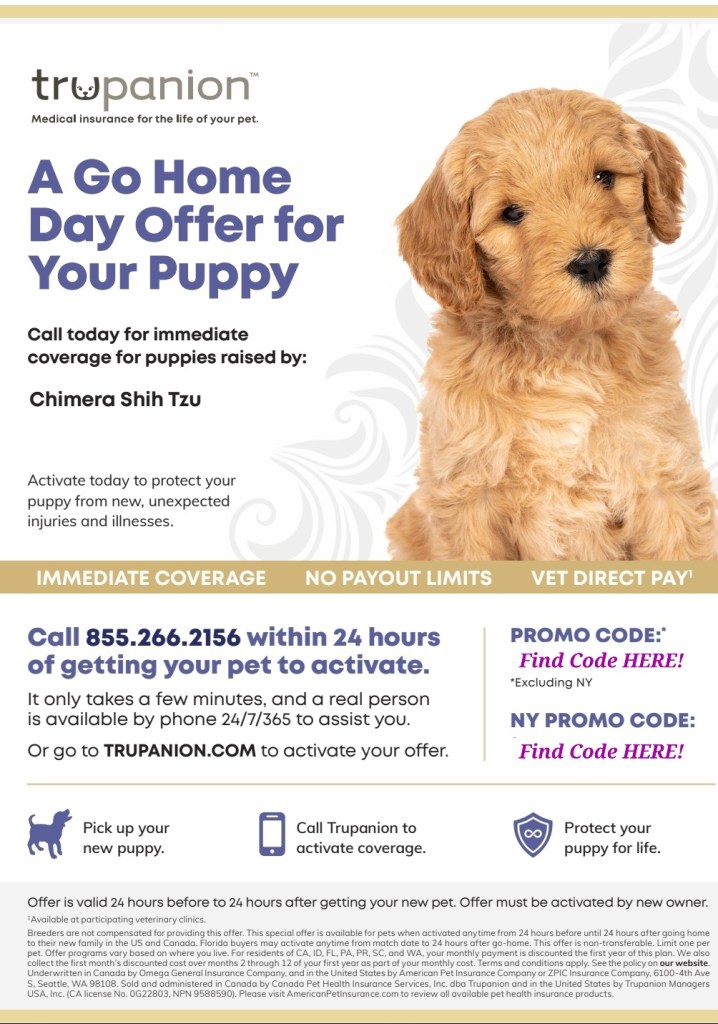
- Trupanion Pet Insurance 30 Days Offer
- Vaccines
- Deworming
- Recommended Items
RESERVE YOUR PUPPY
It all starts when you choose an available puppy. We accept a $200 nonrefundable deposit to reserve the puppy of your choice until they are 9-10 weeks old and cleared by the veterinarian to go home. We will take good care of your baby providing lots of cuddles, kisses, learning opportunities, and socialization until they’re ready to go home to you. The deposit can be paid through Zelle, Venmo, or Good Dog.
The remaining balance can be paid at time of pickup. We accept cash (preferred), Zelle, Venmo, or payments through Good Dog’s processing platform. Good Dog accepts credit cards, debit cards, and bank account transfers through their system. Be aware that some banks do have limits on how much they will allow you to send in Zelle in a 24 hr or 7 day period. Check your bank’s sending limits before depending on this at pickup.
PUPPY PICKUP
Puppies can be picked up between 9 & 10 weeks. We won’t have a firm date for pickup until after we have their 8 week appointments with the veterinarian for their vaccines and health checks. Once we have their FL State Health Certificates in hand, then we can make plans for puppy pickups.
We are in Port Charlotte Florida, along the SE end of Englewood. We are conveniently situated between Tampa, Sarasota, and Fort Myers.
I am very flexible with pickup times and dates. I can normally be available anytime on weekends. I can also be available on some weekdays as long as my husband is home. He works from home often. Just let me know what works best for you and we can see if we can work around that.
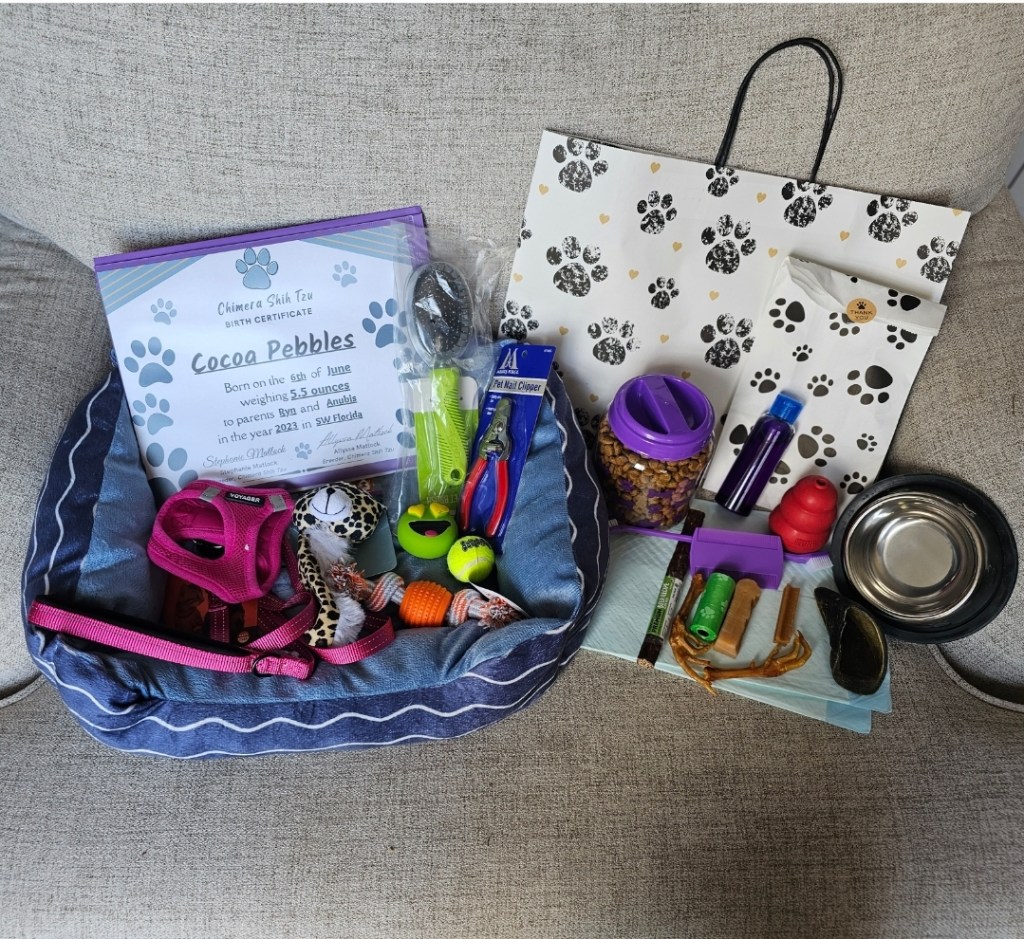
PUPPY GIFT BAG
We send home a few basic items that the puppies are familiar with to help get you started.
- HARNESS – Voyager Harness & leash XXXS size
- DOG BED – A small familiar bed
- FOOD Royal Canin – Small Breed Puppy
- SHAMPOO -Plum Silky
- CHEW TREATS – chicken foot, yak cheese chew, meat stick, cow hoof
- NAIL TRIMMERS – Miller’s Forge
- BRUSH – A small pin brush
- FLEA COMB – Used for combing the face and under the eyes
- TOOTHBRUSH – Used to get puppy familiar with dental care
- TOYS – Small familiar toys
- SMALL BOWL – A small bowl for water while traveling
IN FOLDER
The paperwork folder holds your Florida State Health Certificate. Bring this to your veterinarian at your first appointment. It has vaccine & deworming history that your vet will need to see.
Every vet has their own personal preference on puppy vaccine schedules. Follow your veterinarian’s advice, even if it differs from mine. Your vet knows best! I’m happy to discuss if you have any questions or concerns.
If you have any concerns on the health of your puppy, please let me know and also get them to a veterinarian asap.
- Official FL State Health Certificate from vet (this is your official vaccine record)
- Microchip paperwork, FiNano
- Vaccine & Deworming record
- AKC Limited Registration
- Our puppy health guarantee
- Embark DNA & OFA health testing certificates of parents
- Baxter & Bella Puppy Training 25% OFF code CHIMERA25
- 30 days of Trupanion Health Insurance offer code in folder
FOOD
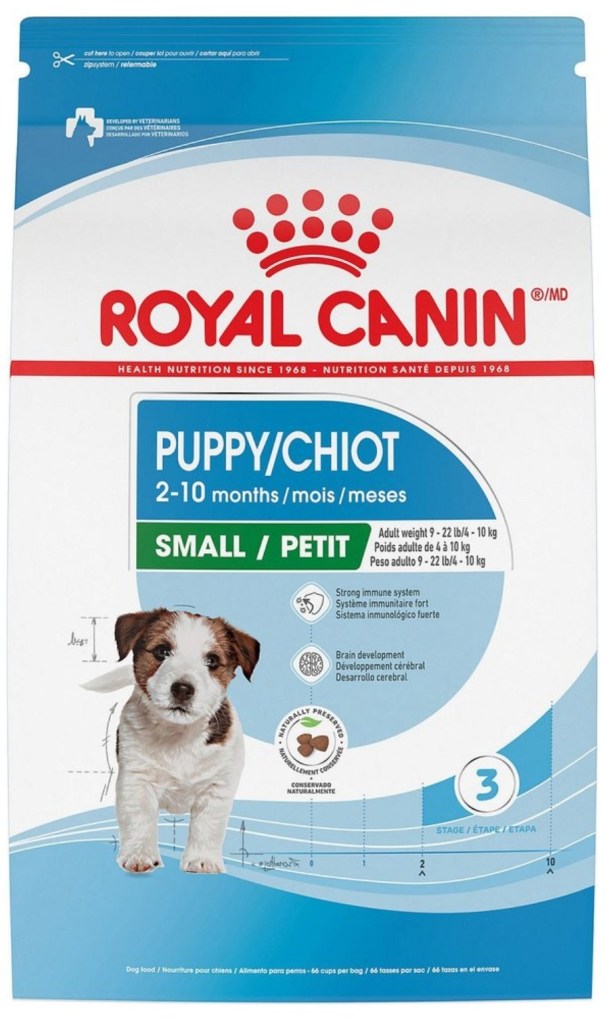
Your puppy has been started on Royal Canin – Small Breed Puppy Food. The food container in your bag has been sprinkled with probiotics to help your puppy’s belly during the stressful transition period.
I free feed puppies under 4 months of age. This means I leave a bowl of food down at all times for them to graze. You can transition your puppy to 2 or 3 scheduled meals per day if you prefer.
They are eating dry food at this age. Don’t give canned food as it can upset their stomach. If you feel they aren’t eating enough you can add warm water to a small bowl of dry food. The water will soak into the food and soften it. They really like this! You can also offer plain cooked chicken as a treat or mixed into their food.
If you would like to change their food to something else, give them a little time before switching. Then you can slowly shift their diet by mixing the old food in with your new choice of food.
Start with 1/4 new food and 3/4 of the Royal Canin I send home, to avoid upset tummy from the change. When poops are solid after the addition of new food, then you can do 50/50 new/old food, then 75/25 new/old food, and finally have 100% of the new food. Watch for tummy upset as young puppies are prone to a variety of infections with such young immune systems. An inflamed or irritated GI tract makes an easy entrance for unwanted visitors such as parasites, bacteria, and virsues.
TREATS
Treats are gret for bonding and training your pup as they learn your routine and expectations. Soft treats are usually accepted more readily. I find the best treats are fresh foods.
When giving treats, especially training, remember this is a TREAT, not a buffer. Give tiny nibbles of food so your puppy is rewarded and quickly turs their attention back to you for more guidance. They want to know how to get more of that good stuff. Use that to your advantage and show them what you want or expect.
I use:
- Cooked chicken, tiny pieces
- Scrambled eggs, tiny pieces
- Zukes mini training treats
- Freeze dried treats (liver, lung, lamb, fish, chicken)
- Cheese, tiny pieces of sliced cheese or a tiny lick from a can of cheese
- Peanut butter, small licks. Be sure there is NO XYLITOL (artificial sugar) in the ingredients.
- Their usual dry food (kibble) can even be used!
TRAINING – Baxter & Bella
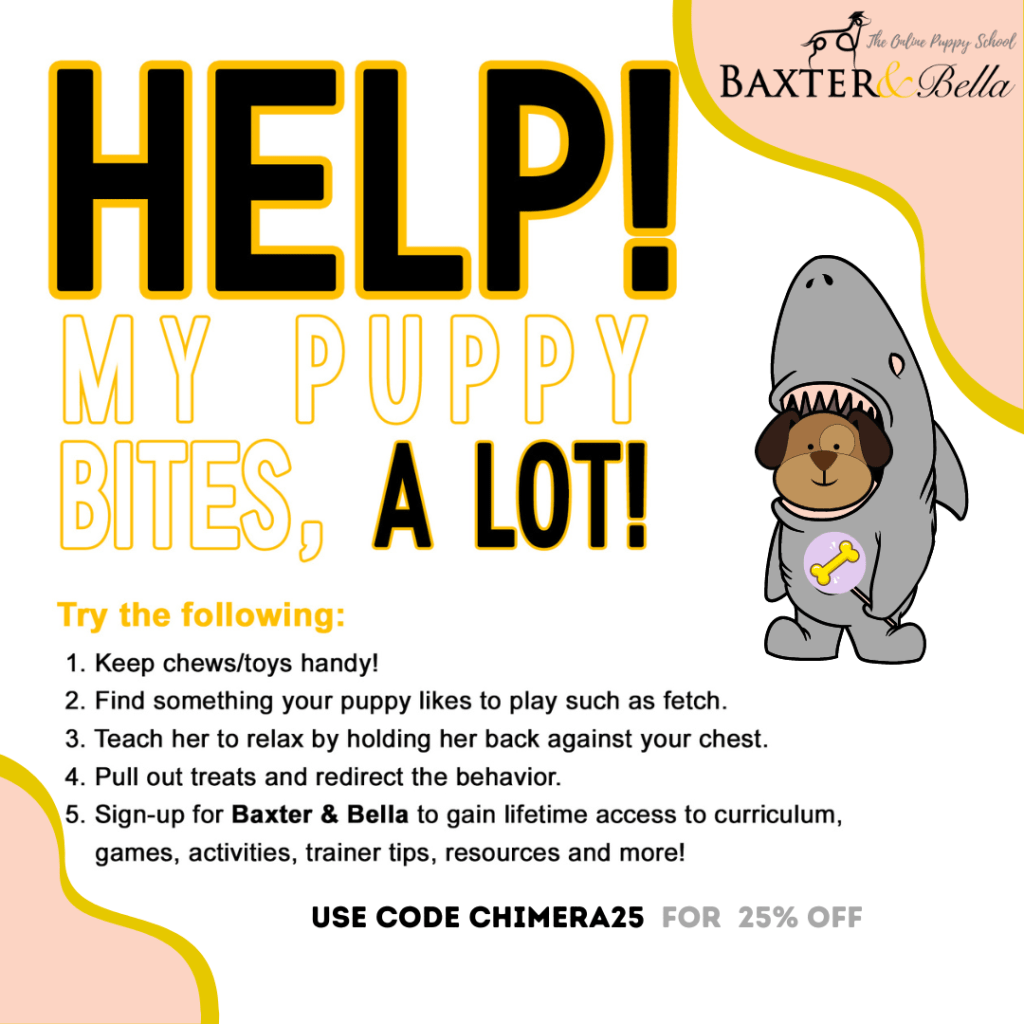
So, you are about to be a puppy parent – Congratulations! Maybe this is your first time or maybe you are adding to your crew, either way, we are so excited for you. We want to make sure that you are prepared to be the very best puppy parent you can be and offer you an amazing resource.
Being a responsible dog owner ensures that you provide a plan to train your canine companion to be the calm, well-mannered and the best behaved doggie that you could ever want. A trained dog is less stressful, not only in the beginning, but for life. Proper socialization and manners will give you the dog you are envisioning. But you have to do the work and stay committed. They deserve it!
Start training them the day they come home and do it from the comfort of your own house. Online training is one thing, but an entire lifetime membership is a whole new adventure for you and your pup. Please get started today, before you pick up your new fur baby, and make a plan to set you both up for success! Make sure to download the app!!
So, how do you do that?
Visit www.baxterandbella.com and use coupon code: CHIMERA25 for 25% OFF. That means for $178, you can feel confident that you are giving your pup and your family the relationship you desire for a lifetime of fun, excitement and happiness!
VACCINE SCHEDULE
Your puppy was vaccinated at 8 weeks old. The actual date is in your folder. This is a 5-way distemper/parvo combo vaccine. They also receive a bordatella (kennel cough) vaccine.
They should continue with puppy vaccines every 4 weeks until 16-20 weeks old, then yearly.
The 2nd 5-way distemper/parvo combo vaccine is due at 12 weeks. Your vet will probably want to give a routine puppy dewormer at that time. They may suggest starting flea/tick & heartworm prevention as well.
If your vet does a 3rd distemper/parvo vaccine, this is due at 16 weeks old.
Rabies vaccine is often given at 16-20 weeks old, then yearly. I like to wait until puppy is a little older. My personal preference would be rabies at 6 months old.
I do not recommend any other vaccines. I avoid leptospirosis vaccines unless the puppy is in a high risk area and then wait until they’re a little older before giving this vaccine. I do not recommend the lyme vaccine or the rattlesnake vaccine.
When possible, it may be safer to space out vaccines, giving the rabies vaccine and 5-way distemper/parvo vaccine at different appointments.
MICROCHIP
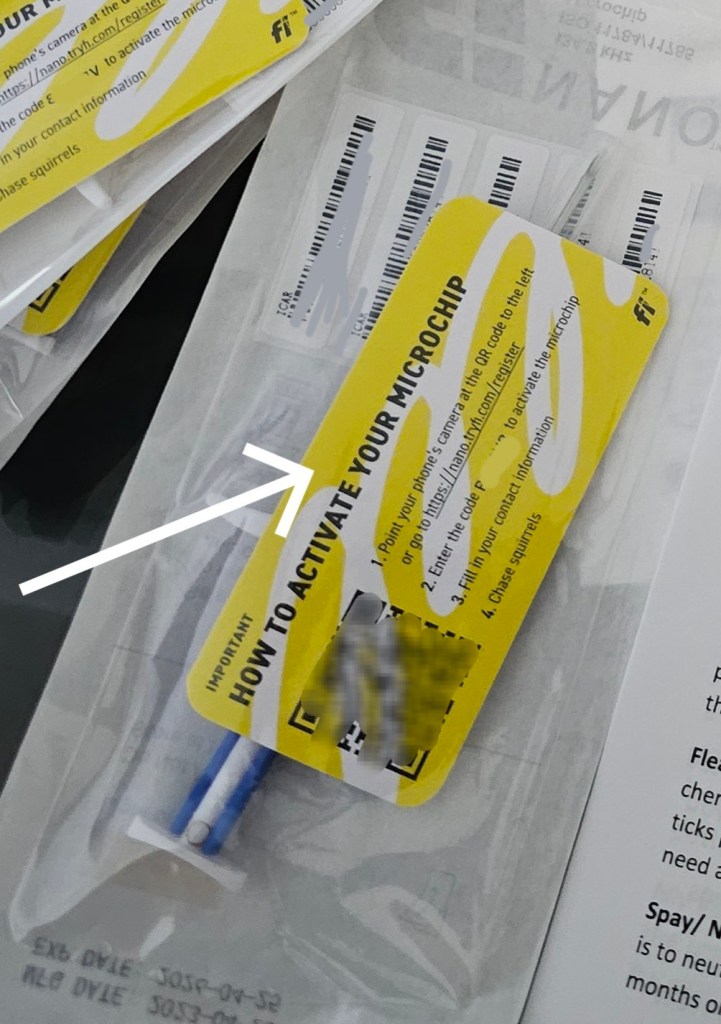
Your puppy has been microchipped with a FiNano brand microchip. Visit nano.tryfi.com/register to register the microchip in your name and enter your contact information so you can be contacted if your Shih Tzu is ever lost. This is a free service included with your FiNano microchip. Look for the yellow card in your folder to get started.
TRUPANION INSURANCE
Trupanion offers our puppy families 30 days of pet insurance that covers new unexpected injuries and illnesses. Activate within 24 hours of bringing your puppy home using code provided in folder. Contact Trupanion for details trupanion.com
We do not receive any compensation or incentives for you to sign up. Our only motive in mentioning this is to help protect your puppy during a vulnerable part of their life. You may choose not to use insurance, or use another company, but signing up for the first 30 days is free and certainly worthwhile if the unthinkable happens and your pup becomes sick or hurt. We DO NOT cover vet bills after your puppy has gone home. It’s a good idea to get the insurance just incase. You can cancel when your trial period is over, risk free.
PARASITES/WORMS
Routine deworming is done the same time as vaccines. Puppies are exposed to many parasites on the ground, so be sure to maintain a good deworming schedule and contact your veterinarian for any alarming poop.
Your puppy tested negative, completely clear of parasites at the veterinarian before going home. We have a strict puppy deworming schedule to make sure there are no hidden dangers.
However, there are many parasites and infections that are harbored in the everyday environment that most people would never even know about. Most of these things wouldn’t cause any harm to a mature, healthy, vaccinated adult dog, but can wreak havoc on a young delicate puppy with immature immune system. Be aware that you can track in viruses, bacterial infections, and parasite eggs on your shoes and even into your house.
Besides the neighborhood dogs, there are many wildlife animals that also carry and drop some of these parasites and infections onto the ground and into your yard. These bacteria, viruses, and parasites can lurk in the soil, grass, or water in your backyard or anywhere else that people, pets, or wildlife have walked.
This isn’t a time to panic or to lock your puppy away from the world, but do be careful and aware to protect your little friend. Keep your pup away from places sick dogs may walk or toilet such as vet office floors, dog parks, dirty water puddles, and pet toilet areas, until they are fully vaccinated and at least 4 months old. If you notice any gastrointestinal symptoms or have concerns of your puppy’s appetite, energy level, or poop, then please contact your veterinarian to discuss.
FLEA/TICK/HEARTWORM
When your puppy leaves here, they aren’t quite big enough yet for flea, tick, or heartworm prevention or control.
Your puppy has NOT been exposed to any of these parasites when they leave our home.
You will want to discuss with your veterinarian what options they recommend for flea, tick, and heartworm prevention or control, depending on their experience and your environment.
Due to the year round warm weather, Florida has a high risk and high rates of infection with fleas, ticks, and heartworm infections that are transmitted by mosquitos. These preventatives are usually given year round in our area. Heartworm prevention is absolutely crititcal to keep your puppy healthy. We have a lot of mosquitoes that can be carrying this dangerous parasite. Even if your Shih Tzu stays indoors, they can still become infected!
Discuss with your veterinarian.
SPAY/NEUTER
Neuter 4-6 months old boys
Spay 6-8 months + girls
We always recommend to connect with a veterinarian you trust, that you are confident in, and that you can ask questions to. Ideally, follow your veterinarian’s advice on the planning of your puppy’s spay or neuter.
In general, our advice is for little boys to have their neuter scheduled before 6 months old. Some veterinarians will say any time after the testicles have dropped. I believe in waiting until at least 4 months old. This will nip those boy hormones before they reach sexual maturity. If they are not neutered by 6 months, they may start marking inappropriately with urine as they lift their leg. This behavior can be curbed with training. However, in pet homes that do not plan on breeding, it’s often best to go ahead and neuter before this habit becomes an issue.
Girls are a little slower to develop and can use those hormones during their growth and development. Whether you choose to spay before or after their 1st heat cycle is up to you, your vet, and your situation. I personally do not spay before 6 months old but I also absolutely don’t believe they need to have a litter just for the experience. Breeding comes with many risks. If you’re interested in breeding and serious about doing so responsibly, please feel free to talk openly with me. If you plan to spay, discuss the best timeline with your trusted veterinarian. It is important to avoid unplanned litters.
I typically expect a cost of $100-300 for the average spay or neuter. Spays are more expensive than neuters. Costs will be higher if there are additional services such as pre-surgery bloodwork, vaccines, or hernia repair. Many veterinarians are going to be over $600. If you are looking for a lower cost spay or neuter, search online for “low cost spay neuter near me” to find low cost clinics. Also check with your local shelters or humane societies on who they recommend for lower cost spays and neuters.
POTTY TRAINING
Your puppy has started on potty training using potty pads. We encourage you to continue this training with structure for good habits that will last a lifetime.
A puppy pen will help your puppy maintain routine when they aren’t being supervised. These pups are so tiny & young when they go home, it helps them a lot to have a safe space they can rest, potty, eat, and play while they are getting acclimated with their new environment and family. They can be in their pen anytime they aren’t being supervised. This keeps them safe, prevents them from chewing furniture or cords, keeps them away from doors, and keeps them from pestering another pet that isn’t quite ready for puppy in the face affection. I use a puppy pen with a bed, a potty pad, a couple toys, food & water dishes. Just the essentials.
The pups are familiar with potty pad training, but they are babies!! Going to a new home is like us walking into a huge department store or mall. When you gotta go, running around trying to find the sign for the bathroom, you end up on the wrong side of the store and then have to hussle back to the other wall before you spring a leak! Think from the puppy’s perspective, silly little babies, they get distracted, engaged, forget where the potty is, or don’t feel the urge until it’s too late to get all the way back, if they can even find their way.
My #1 rule is getting your puppy to the potty BEFORE they realize they need to go. If you wait until they feel the urge, you may be too late. They are learning SO MUCH at this age, and the transition to a new home can be a lot to process.
When puppies are learning their new space, I like to put them in their potty area (whether you do pads, a pen, or outside):
- Every 15 minutes that they are up / playing / walking around
- As soon as they wake up from a nap, morning ect
- Before they come out of their pen to play or snuggle – potty 1st!!
- As soon as you get home, they see you get excited, distracted, potty 1st!
- After eating
- When in doubt, offer the potty! Then play, snuggle, eat, explore, engage.
Offering the potty frequently helps them to remember where it is and keeps it in the front of their mind that is the designated area to toilet. So as they are blown away by the awesomeness of their new house, family, dog friends, toys, new beds, new sounds and lights and so much fun – oh yeah, and there’s my potty. A little helping hand goes a long way in developing good lifelong potty habits and manners.
GROOMING
A puppy visit at the groomer is usually just to acclimate them to the environment. They may trim nails, paw pads, tush, and or around the eyes, but a good groomer knows this is more of a training visit than a polished look visit. We are building positive associations with the grooming salon for your puppy, not pushing them to a full-length groom. I encourage you to set this appointment up as soon as your groomer will allow.
Some groomers will schedule puppies after their first vaccines. Some go as far as to wait until after rabies vaccine, which is usually at 4 months old. If you have a preferred groomer, follow their advice. If you’re looking for a groomer, ask their criteria or minimum age for a puppy visit. Call around until you find the right fit. A little extra effort in the beginning will help make grooming sessions far easier and less stressful for the rest of their life.
Grooming at home should also be done regularly with the priority of making positive experiences. It’s not worth brushing out a tangle if the puppy is going to be fearful of the brush.
My rules for grooming:
- NEVER groom if you’re in a rush, irritated, distracted, or impatient
- Give the puppy ample praise and patience. This is a learning experience!
- Never force a scared puppy. Listen to your baby’s body language. They can be stubborn and need direction, but if they become scared you will do more harm than good.
- Groom when you AND pup are in the right mindset. When you are eager to work with puppy and preferably when puppy is worn out.
- Early grooming gets lots and lots of praise, treats, bites of chicken, and yummy chews like chicken feet to keep them relaxed, happy, and focused on the task.
- Give puppy a good play session to wear out and run around. Once they settle down for a nap fully relaxed is a great time to gently introduce grooming.
- Don’t worry about cutting or maintaining hair, just focus on teaching the SKILLS your puppy will use as they mature into long haired dogs.
- Sit in the evenings watching tv, with a special chew for puppy, while caressing with a brush. Remember, it should feel good for puppy!
- Trim just the tip of the toenails every 2 weeks.
- Baths every 2-3 weeks. Don’t let puppy get cold! Use very warm water and have towels nearby.
- Brush and comb all over, every day! Just make sure it’s POSITIVE for puppy.
TEAR STAINS
POOP EATING – COPROPHAGIA
STENOTIC NARES
Shih Tzus are a breed prone to Stenotic Nares, also called pinched or tight nostrils, due to the shape of their face. The flatter & squishier the face, the more likely the nostrils are to be tight. Most commonly however, this is only temporary while they are teething. While Shih Tzu puppies are teething, there can be some temporary soft tissue swelling. This can last for 6 months or more, usually less, and resolves on its own with nothing to worry about. While their nostrils are tight, they may wheeze a little more with the restricted airflow. You may see some clear water droplets or bubbles around the nose. The puppy may sneeze a little to clear the nasal passage. These are not cause for concern. Once their adult teeth are fully erupted it will open their face a little more, making more room for those nostrils to open back up.
Some veterinarians may jump the gun wanting to perform surgery on Shih Tzu puppies to give them wider nostril openings. We do not recommend this. Just give that baby time to grow up and mature into their breed features.
If you have any concerns, do feel free to consult a trusted veterinarian familiar with the breed, and follow their guidance.
We trust Dr. Shaw @ Choice Vet in Punta Gorda.
UNDERBITES
An underbite is when the bottom jaw grows beyond the length of the top jaw. In some breeds this is considered a fault and may sometimes be pointed out by your veterinarian. In Shih Tzus, an underbite is a featured part of the breed standard. They are intentionally bred with the bottom teeth sticking forward just a little farther than the top teeth to give that flat face & endearing smile. This is perfectly fine!
However, there are varying degrees of underbites. We aim for a close or tight bite, keeping the top and bottom teeth as close together as possible. Genetics vary with each individual dog though and some puppies are going to have a bottom jaw that goes a little more forward than we intend. We will let you know before you pickup your puppy if we anticipate any noticeable variances from the breed standard, if your pup might have a more pronounced underbite.
Always feel free to discuss any concerns with your trusted veterinarian, but it’s very uncommon for an underbite to cause any issue for our Shih Tzus. Most of the time the worst-case scenario it just gives them the cutest toothy grin!!
RECOMMENDED ITEMS
Look for links on our recommended items page
- • My favorite training treat is tiny bites of cooked chicken.
- • Zukes Mini treats are also great. They’re small, soft, easy to chew/eat and leave them eager for more – so they look right back to see what they need to do to earn another! Lots of Flavors https://amzn.to/3z4RFCQ
- • Puppy Pen. I like starting puppies in a penned area that has a bed, toys, chews, and potty pads. As they get used to the house and routine they can have more and more supervised time out of the pen and then start having unsupervised time as their potty habits remain good. This is a good size for short periods in a pen. Some people put two together for more Play space. https://amzn.to/3O27qi9
- • This baby gate/ play yard can be used as a stand alone pen, or as a gate to a wide opening. I’ve used it as both. I’ve also used it in a U or L shape to block the front door so dogs can’t dart out when the door opens. Super versatile and enough to make a nice sized puppy safe area. https://amzn.to/3RDvqLQ
- • Plum Silky Dog Shampoo. You can use any dog or puppy shampoo, whatever you like, but a lot of people ask what shampoo we use because they like the scent when the puppies go home. https://amzn.to/3AUZrkl
- • Chicken Feet. I like to offer natural chews and treats. Chicken feet are great for teething and boredom. https://amzn.to/3z8hqT3
- • You can continue using potty pads or teach them to potty outside. Any potty pads are fine. I like Costco the best, they are large, and Sam’s is good too. Here’s some on Amazon. https://amzn.to/3O8i1bi
- • I feed the puppies Royal Canin – Small Breed Puppy Food. I’ll send a small bag home so you can transition to the food of your choice, or continue the same food if that works for you
- • Nontip food water bowls are nice to have! https://amzn.to/3z61jVV
- • Voyager harnesses. I use these on all my dogs. I send puppies home with the size they fit in at the time, usually XXXS. They grow so fast at this age, if you want to order a bigger size of the same style later: https://amzn.to/3PrVffH
- • Mini Trimmer. I use this handy little trimmer in my videos. I love it. I use it for tushies, under the feet (paw pads), under the eyes, and between the eyes. https://amzn.to/3uOQhBY
- • Nail Trimmers. These are my favorite nail trimmers. I send a pair home with each puppy. https://amzn.to/3ParYX4
- • Toys. The puppies like lots of toys. They like soft things to mouth on, lightweight toys to run with or fling about, things that Crinkle or squeak.
- • Teething. While they are teething they also like things to chew on. Chicken feet, pig ears, nylabones ect.
 Chimera Shih Tzu